
【2025.09】Project Financial Disclosure | The 1st Chinese Conference on Familial Hypercholesterolemia & Integrated Patient Support Event
From September 19 to 21, 2025, the inaugural Familial Hypercholesterolemia (FH) Conference and Patient Exchange Meeting, initiated and hosted by the Homy FH China Patient Network with collaborative support from the Chinese Organization for Rare Diseases (CORD), was successfully concluded.
The event brought together leading domestic FH clinical experts, authoritative scholars, FH patients and their families, and industry representatives. In-depth discussions were held on a wide range of topics, spanning from childhood to adulthood, diagnosis to treatment, and medication to psychological support. Recalling the highlights of the conference, the warmth and moving moments remain vivid.
As a conference spontaneously organized by a patient community organization, our resources were finite, but our dedication was limitless. Today, we wish to share with you the story behind the numbers. This is not merely a record of income and expenditure, but a sincere testament to creating boundless possibilities for the FH community under limited conditions.
We hereby disclose the financial details of this conference as follows:
Part 1: Overview
 Part 2: Detailed Expenditures
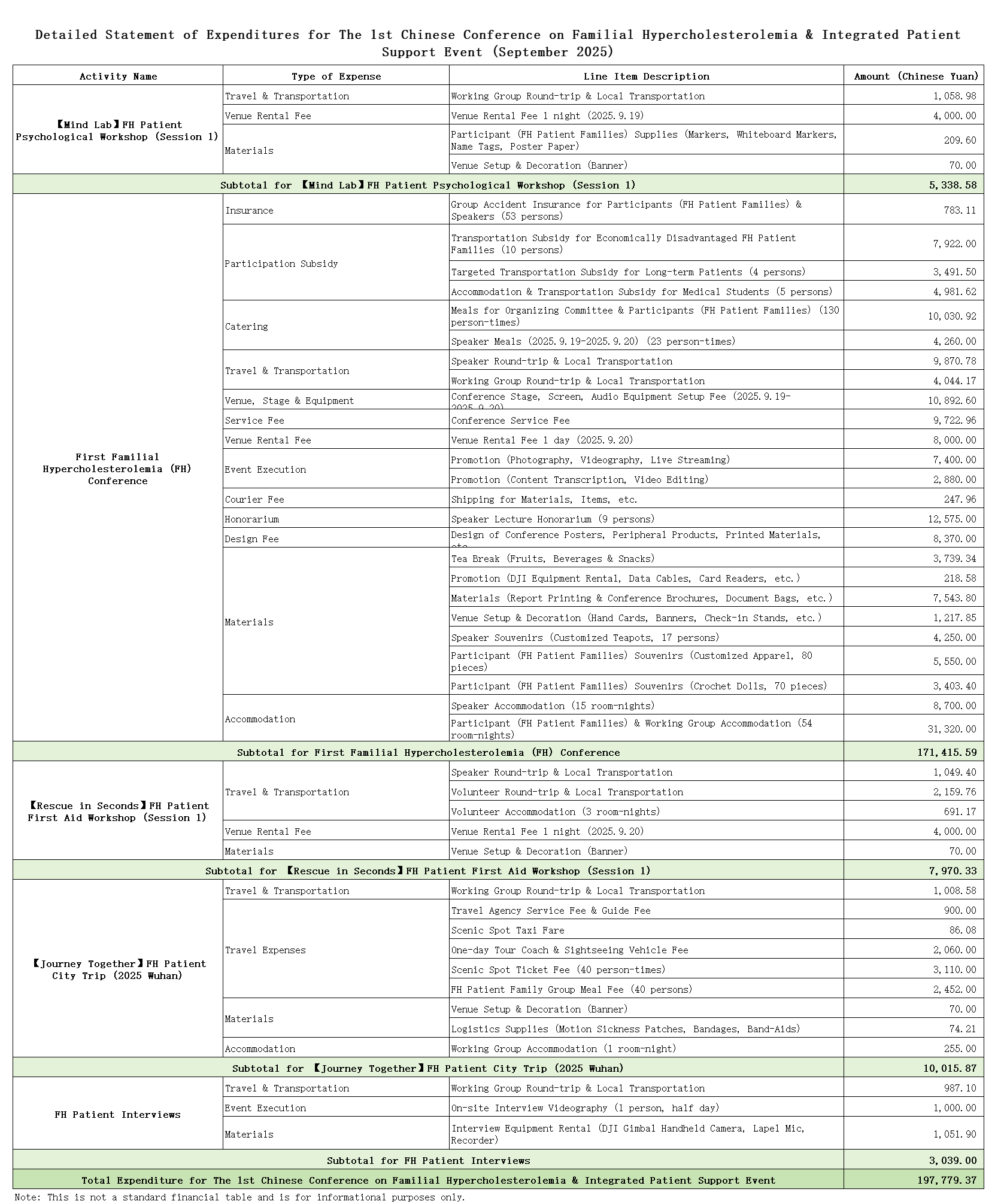
Part 3: The Story Behind the Numbers
The FH community in China has been facing severe challenges. According to research reports, there are an estimated 5.6 million patients with Heterozygous Familial Hypercholesterolemia (HeFH) in China, yet the diagnosis rate is less than 1%. For Homozygous Familial Hypercholesterolemia (HoFH) patients, estimated at 5,000 [1-2], the diagnosis rate is only about 5% [3]. Even after diagnosis, up to 95% of patients fall far short of reaching their low-density lipoprotein cholesterol (LDL-C) treatment targets [3], indicating an extremely critical situation in diagnosis and treatment management. However, no large-scale conference themed specifically on FH had ever been held domestically, with only some small-scale free clinic activities available. Effective interaction among clinicians, researchers, FH patients, and pharmaceutical/device companies has been lacking, making it difficult to truly present the current situation and demands of the FH community.
This was precisely our original intention for going all out to initiate and host this conference, even with severely limited funding. We firmly believe that dialogue is the beginning of change. We were committed not only to building a platform for integrated communication that breaks down barriers between doctors, patients, companies, and researchers but also to doing our utmost to ensure that no voice eager to participate would be absent due to practical obstacles.
To this end, and despite extremely limited resources, we provided comprehensive support for participants at this conference:
We provided free accommodation and full catering for 30 registered FH patient families.
We set up a dedicated, healthy, low-fat tea break area and ensured medical emergency support at the venue.
We purchased accident insurance for all participants and arranged a warm and welcoming Wuhan city trip.
Most importantly, to break down the barriers of distance and economic constraints, we specifically subsidized 14 FH patient families, providing each with a 1,000 CNY transportation subsidy. We also provided a 1,000 CNY transportation and accommodation subsidy to 5 medical students whose research focus is FH.
Through building such a platform, we hoped to enable everyone concerned about the future of FH in China, regardless of background or identity, to have the opportunity to participate and become part of this transformative effort.
We are keenly aware that the road to improving FH diagnosis and treatment in China is long and challenging. This conference is not an endpoint, but a starting point. The path ahead still requires more strength. We look forward to joining with more companions in the future to kindle these sparks into a dawn that illuminates the future for more FH families.
Conclusion
Moving forward, the Homy FH China Patient Network will continue to strive ahead, working hand-in-hand with everyone to advance the development of FH diagnosis and treatment in China, ensuring that change continues to happen!
Fighting Hard for a brighter future!
References
[1]Chen P, chen X, Zhang S. Current Status of Familial Hypercholesterolemia in China: A Need for Patient FH Registry Systems[J].Front Physiol.2019 Mar 20;10:280.
[2] Huang MN, Wang CC, Ma MS, Chi MZ, Zhou Q, Jiang LH, Wang CL, Lu M, Chen XQ, Cheng YY, Ke Q, Wang DY, Qian XX, Ying XM, Zhang JP, Shen QH, Liu LF, Gu R, Zhang ZJ, Feng JH, Wang M, Zhu MQ, Huang K, Fu JF, Zou CC. Familial hypercholesterolemia in Chinese children and adolescents: a multicenter study. Lipids Health Dis. 2024 Dec 27;23(1):423. doi: 10.1186/s12944-024-02406-4. PMID: 39731075; PMCID: PMC11681761.
[3] CuchelM, RaalFl, Hegele RA,et al,2023 Update on European Atherosclerosis Society ConsensusStatement on Homozygous Familial Hypercholesterolaemia: new treatments and clinical guidancell. EurHeartJ.2023Jul1:44(25):2277-2291.
